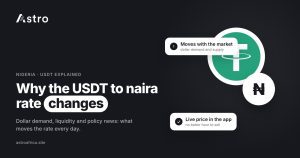
The USDT to naira rate changes every day because USDT is designed to track the US dollar, so its naira price moves whenever the value of the dollar against the naira moves. Dollar demand and supply in Nigeria, activity in the official FX market, liquidity on exchanges, P2P trading and policy news all feed into that price, which is why the number you see in the morning may not be the number you see later.
This guide explains what drives the USDT to naira rate, why buy and sell prices are never the same, what weekends and holidays mean for the wider market, and how to check the live rate on Astro before you sell.
Key points
- USDT is a stablecoin that tracks the US dollar, so the USDT to naira rate largely follows the dollar to naira rate.
- Dollar demand and supply, the official FX market, exchange liquidity, P2P demand and Central Bank of Nigeria (CBN) policy news can all move the rate.
- Every platform shows a buy price and a sell price. The gap between them is called the spread.
- On Astro, rates do not depend on the time of day or the day of the week. They follow the market.
- The only reliable rate is the live one. Check it in the Astro app before you trade.
What is USDT, and why is it tied to the dollar?
USDT (Tether) is a stablecoin. Unlike Bitcoin or Ethereum, whose prices can swing widely, USDT is designed to hold a value close to one US dollar.
That design is the key to understanding the rate. When someone in Nigeria sells USDT for naira, they are, in practical terms, selling a dollar-linked asset for naira. So the USDT to naira rate behaves much like a dollar to naira rate. If the naira weakens against the dollar, one USDT tends to fetch more naira. If the naira strengthens, one USDT tends to fetch less.
USDT itself can move slightly above or below one dollar on global markets, but those moves are usually small. In Nigeria, most of the day-to-day change in the USDT to naira rate comes from the naira side of the pair, not from USDT. For a wider look at why Nigerians hold stablecoins in the first place, see USDT vs naira: why stablecoins are gaining popularity in Nigeria.
What moves the USDT to naira rate?
No single factor sets the rate. It is the result of many buyers and sellers reacting to the same broad conditions. These are the main ones.
1. Dollar demand and supply in Nigeria
Like any price, the naira value of the dollar depends on how many people want dollars and how many dollars are available. Importers paying foreign suppliers, families paying school fees abroad, travellers and businesses settling international invoices all add to dollar demand. Export earnings, remittances from Nigerians abroad and foreign investment add to supply. When demand rises faster than supply, the dollar, and with it USDT, tends to cost more naira.
2. Moves in the official FX market
Nigeria’s official foreign exchange market sets a reference point that many traders watch. When the official rate moves, crypto markets often adjust in the same direction, because people compare the two and shift their trading to whichever looks better. The USDT to naira rate on crypto platforms is not the same as the official rate, but the two tend to influence each other.
3. Liquidity on exchanges
Liquidity means how much USDT and naira are available to trade at any moment. When there are plenty of buyers and sellers, prices tend to be steadier and large trades move the price less. When liquidity is thin, even a few big orders can push the rate up or down.
4. P2P demand
Peer-to-peer (P2P) trading, where individuals buy and sell USDT directly with each other, is a large part of Nigeria’s crypto market. P2P prices react quickly to what people are willing to pay, and they can rise or fall faster than other markets when demand shifts. Because so many Nigerians use P2P, it helps shape the wider USDT to naira price. If you want to understand how P2P works and its risks, read what P2P crypto trading is and why Astro is a safer alternative.
5. CBN policy and economic news
The Central Bank of Nigeria sets monetary policy, including interest rates and rules around foreign exchange. Announcements about FX policy, interest rate decisions, changes to how banks handle dollar transactions or rules affecting crypto can all change how traders behave. Wider news, such as inflation figures, oil prices and foreign reserves, also affects confidence in the naira.
This guide does not try to predict where the rate will go next. Nobody can reliably say whether the naira will rise or fall on a given day, and anyone who promises you they can is worth treating with caution.
6. Weekends and public holidays in the wider market
Crypto markets run every day, but traditional markets do not. Banks and the official FX market slow down or close on weekends and public holidays, while crypto and P2P trading keep going. In the wider market, this can change how much trading happens and how quickly prices respond to news.
On Astro, though, rates do not depend on the time of day or the day of the week. There is no better hour, day or season to sell on Astro; the rate simply follows the market at the moment you trade. The only rate that matters is the one shown in the app when you confirm.
Buy price vs sell price: what is the spread?
When you look up the USDT to naira rate, you will usually see two numbers rather than one:
- The buy price: what you pay in naira to get one USDT.
- The sell price: what you receive in naira when you sell one USDT.
The buy price is normally higher than the sell price. The difference between the two is called the spread. Every exchange, bank and FX dealer works this way: the spread covers costs and the risk that prices move while the business holds the asset.
Spreads tend to be narrower in calm, busy markets and wider when prices are jumping around or there are fewer traders.
This is why comparing “rates” between apps can be confusing. Make sure you are comparing the same thing: the sell price if you are selling, and the buy price if you are buying. On Astro, Nigerian users can both buy and sell USDT with naira, and the app shows the exact naira amount for your trade before you confirm.
| Buy price | Sell price | |
|---|---|---|
| What it means | Naira you pay for 1 USDT | Naira you receive for 1 USDT |
| When it applies | Buying USDT with naira | Selling USDT for naira |
| Usually | The higher of the two | The lower of the two |
How to check the live USDT to naira rate
Because the rate moves throughout the day, any number printed in an article, a screenshot or a social media post can be out of date within hours. This guide deliberately does not quote a rate for that reason.
To see the current rate:
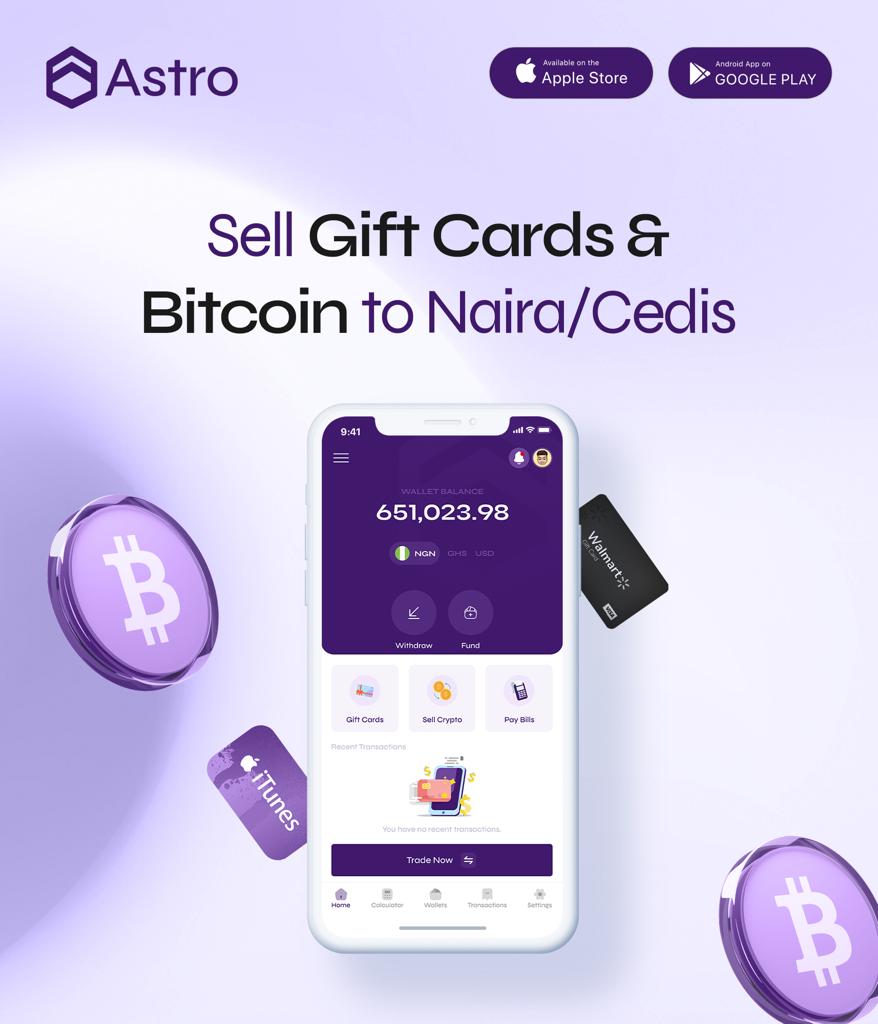
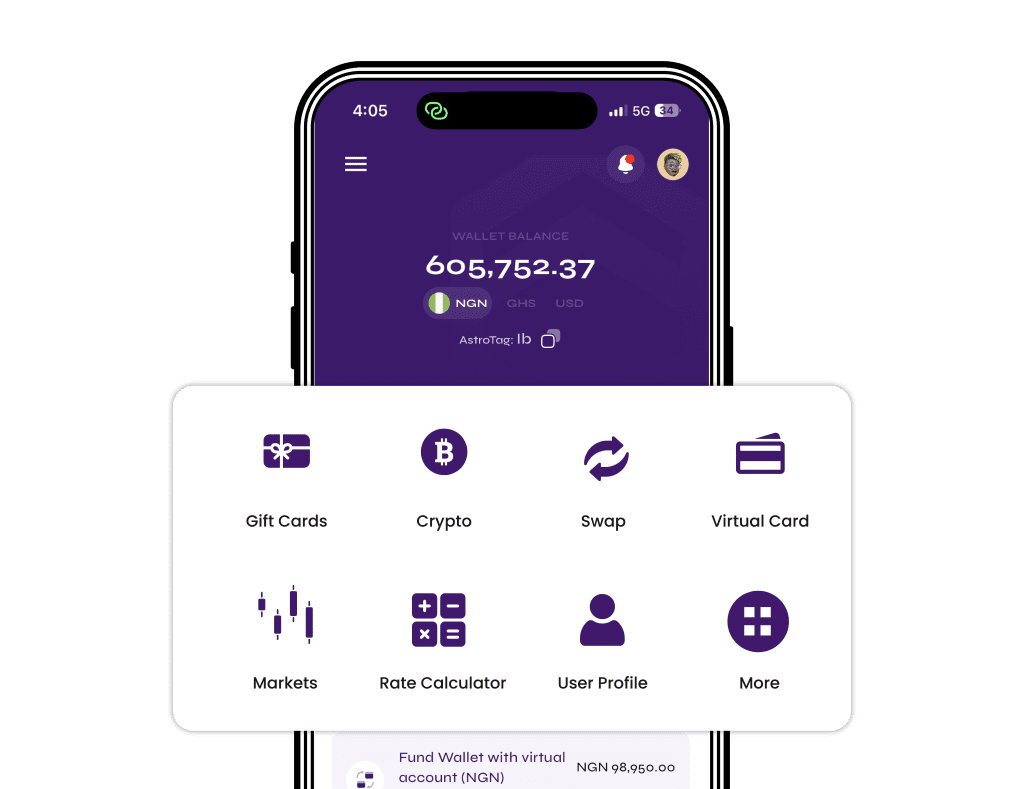
- In the Astro app: open your USDT wallet and tap sell. Enter the amount and the app shows the naira value you will receive before you confirm.
- For gift cards: the live rates page on the website lists gift card prices. The USDT price is shown in the app.
Always rely on the figure shown at the moment you confirm, and be wary of anyone on social media offering a rate far above what the market shows. Unusually generous rates are a common hook in crypto scams.
Selling USDT for naira on Astro
Once you have checked the live rate, selling USDT on Astro takes a few steps. The short version is below; the full walkthrough is in the guide to selling USDT in Nigeria and getting paid in as fast as 60 seconds.
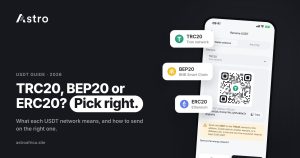
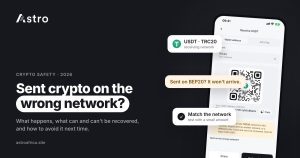
- Deposit USDT. In the app, open your USDT wallet, choose the network (TRC20, BEP20 or ERC20) and copy the deposit address for that network. Send from your exchange or wallet on the same network. USDT sent on the wrong network, or sent as a different coin, cannot be recovered.
- Sell for naira. Enter the amount, review the naira value and confirm with your 5-digit PIN or Face ID.
- Withdraw to your bank. Send your naira to a Nigerian bank account, including fintech banks such as OPay and PalmPay. The least naira withdrawal is ₦300.
Eligible payouts can arrive in as fast as 60 seconds under normal conditions. Blockchain confirmations, network congestion, bank delays and maintenance can affect timing, so not every payout will land that quickly. Payouts also run on weekends and public holidays, although bank-side delays can still affect when the money arrives.
Fees can change, so check the amount shown in the app before you confirm rather than relying on a figure from elsewhere. If a withdrawal fails, everything taken is refunded, including the withdrawal fee. A withdrawal that is already processing cannot be cancelled.
Sign-up does not ask for ID, and standard crypto trading and crypto withdrawals do not need ID verification. Some features, such as Nigerian bank accounts and virtual dollar cards, do require verification.
Staying safe while the rate moves
Rate changes create openings for scammers, especially in P2P deals and social media trades. A few habits help reduce the risk, though no method removes it completely:
- Check the rate yourself in the app instead of trusting screenshots.
- Be cautious of anyone offering a rate far above the market, or pressuring you to trade quickly.
- Never share your PIN, one-time codes or recovery phrases with anyone, including people claiming to be support staff.
- Double-check the network and address before sending USDT.
- Turn on the optional two-step check with an authenticator app for outside crypto sends.
For more on picking a platform you can trust, see how to choose a platform to buy and sell USDT in Nigeria.
Frequently asked questions
Why does the USDT to naira rate change every day?
USDT tracks the US dollar, so its naira price follows the dollar to naira rate. Dollar demand and supply, the official FX market, exchange liquidity, P2P demand and policy news all affect that rate, so it moves from day to day and often within a single day.
Is the USDT to naira rate the same as the dollar to naira rate?
They are closely linked but not always identical. USDT trades on crypto markets, which can differ from the official FX market and from bank rates. The gap between them changes with market conditions.
What is today’s USDT to naira rate on Astro?
Rates move throughout the day, so the current rate is always shown in the Astro app when you enter an amount to sell. Use the rate shown at the moment you confirm.
Why are the buy and sell prices different?
The buy price is what you pay for one USDT and the sell price is what you receive for one USDT. The gap, called the spread, covers costs and market risk. It exists on every exchange and FX service.
Are rates on Astro better at certain times of day?
No. Rates on Astro do not depend on the time of day or the day of the week. They follow the market, so the rate you get is the one shown when you confirm the trade.
Does CBN policy affect the USDT to naira rate?
It can. Announcements about foreign exchange rules, interest rates or banking policy can change how traders behave, which can move the naira against the dollar and, in turn, the USDT to naira rate.
Which USDT networks can I use to deposit on Astro?
Astro supports USDT on TRC20, BEP20 and ERC20. Copy the deposit address for the exact network you plan to send on, and select that same network in the sending app.
Can I sell USDT on Astro on weekends and holidays?
Yes. Payouts run on weekends and public holidays. Bank delays or maintenance can still affect when the money arrives in your account.
What is the least amount of naira I can withdraw?
The least naira withdrawal on Astro is ₦300. Withdrawals go to Nigerian bank accounts, including OPay and PalmPay.
Do I need KYC to sell USDT on Astro?
No. Sign-up does not ask for ID, and standard crypto trading and crypto withdrawals do not need ID verification. Some other features, such as Nigerian bank accounts and virtual dollar cards, do require verification.
The USDT to naira rate moves because the dollar to naira rate moves, and no article can tell you exactly where it will be tomorrow. What you can do is check the live rate before you trade. Download the Astro app to see the current USDT to naira rate, sell in a few taps and withdraw to your Nigerian bank.