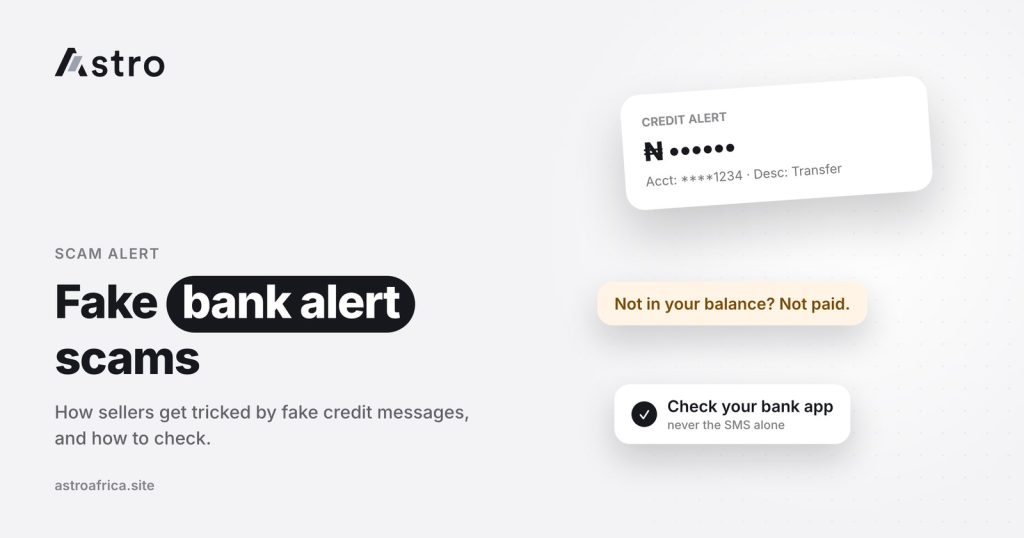
A fake bank alert is a false message, usually an SMS, email or screenshot, made to look like your bank has credited your account when no money has actually arrived. Scammers use them to trick crypto and gift card sellers in Nigeria into releasing coins or codes before payment is real, and the only reliable defence is to confirm the money in your own bank app or account balance before you hand anything over.
This guide explains how fake bank alert scams work, the signs to look for, how to confirm a real payment, how to sell crypto and gift cards in a way that avoids the problem, and what to do if you have already been tricked.
Key points
- A credit SMS, email or screenshot is not proof of payment. Only your actual account balance is.
- Fake alerts are common in person-to-person (P2P) crypto trades and private gift card deals.
- Scammers add pressure, such as “I’ve paid, release now”, to stop sellers from checking.
- Selling to a platform such as Astro means the payout comes from the platform, not from a stranger, which removes the fake-alert step from the trade.
- No method removes every risk. Keep checking, and never share your PIN, OTP or recovery phrase.
What is a fake bank alert?
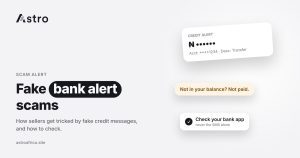
In Nigeria, most people learn about incoming money through a credit alert: a text message or email from the bank saying an amount has landed. A fake bank alert copies that format. It can show the right bank name, a realistic amount, a transaction reference and even your account number, but it is not from the bank and no money has moved.
Fake alerts come in a few forms:
- Spoofed SMS. A text that appears under the bank’s name or a similar sender ID, written to look like a real credit alert.
- Edited screenshots. A picture of a “successful transfer” receipt, made or edited in an app, then sent on WhatsApp or Telegram.
- Fake emails. Emails designed to look like bank notifications, often from addresses that are close to, but not the same as, the bank’s real address.
- Payment that is later reversed. Real money is sent from a stolen or fraudulent account and later pulled back by the bank, leaving the seller without the money and without the goods.
How the scam works on crypto and gift card sellers
Fake alerts work best when a seller has to release something valuable to a stranger who claims to have paid. That makes person-to-person trades an easy target.
P2P crypto trades
In a typical P2P crypto deal, the buyer sends naira to the seller’s bank account, and the seller then releases USDT, BTC or another coin. A scammer posing as a buyer sends a fake alert or a doctored receipt, then rushes the seller to release the crypto. Once the coins are sent, the transfer can’t be reversed, and the “buyer” disappears.
Some scammers use a twist: they send a fake alert for more than the agreed amount, then ask the seller to “refund the extra”. The seller sends real money back for money that never arrived. For more on staying safe in these trades, read P2P crypto trading in Nigeria: best practices and how to avoid fraudulent Bitcoin vendors in Nigeria.
Private gift card deals
The same trick appears in gift card sales arranged on social media. A “buyer” asks for the card code, shows a credit alert or a transfer screenshot, and the seller sends the code. Gift card codes can be redeemed within seconds, so by the time the seller finds the alert was fake, the value is gone.
Goods, services and “wrong transfer” stories
Fake alerts are also used against shops, POS agents and freelancers. A related trick is the “wrong transfer” story: someone claims to have sent money to your account by mistake, shows a fake alert, and begs you to send it back. If the money isn’t in your real balance, there is nothing to return.
Signs an alert may be fake
No single sign proves an alert is fake, but these should make you stop and check:
- Your balance hasn’t changed. This is the most important sign. If the money isn’t in your account balance, it hasn’t arrived.
- The alert came as a screenshot. A picture of a receipt proves nothing. Anyone can make or edit one.
- The buyer is in a hurry. “Release now, my boss is waiting” or “I’ve paid, why are you delaying?” is a pressure tactic.
- The alert format looks slightly off. Wrong balance format, spelling errors, odd spacing, or a sender name that differs from earlier genuine alerts.
- The amount is more than agreed. Followed by a request to refund the difference.
- The SMS shows no correct available balance. Many genuine alerts show your new available balance. A fake one may show a figure that doesn’t match your real balance.
How to confirm a payment is real
Checking takes a minute and can save a large loss.
- Open your bank app or internet banking yourself. Don’t use any link the buyer sends. Log in the way you normally do.
- Check the available balance, not just the transaction list. Make sure the amount has been added and is available to spend.
- Match the sender’s name. Check that the name on the credit matches the person you are trading with. A mismatch can mean the money came from a third party’s account, which raises the risk of a later reversal.
- Wait if anything looks unusual. A genuine buyer can wait a few minutes while you confirm. Someone who refuses to wait is a warning sign.
- If in doubt, call your bank. Use the number on the bank’s official website or the back of your card, not a number in the message.
Never release crypto or a gift card code until the money is in your available balance. That single rule stops most fake alert scams.
Why selling to a platform avoids this step
Fake alerts depend on a stranger “paying” you directly. When you sell crypto or a gift card to a platform instead of an individual, there is no buyer sending you a transfer, so there is no alert to fake.
On Astro, the trade works the other way round:
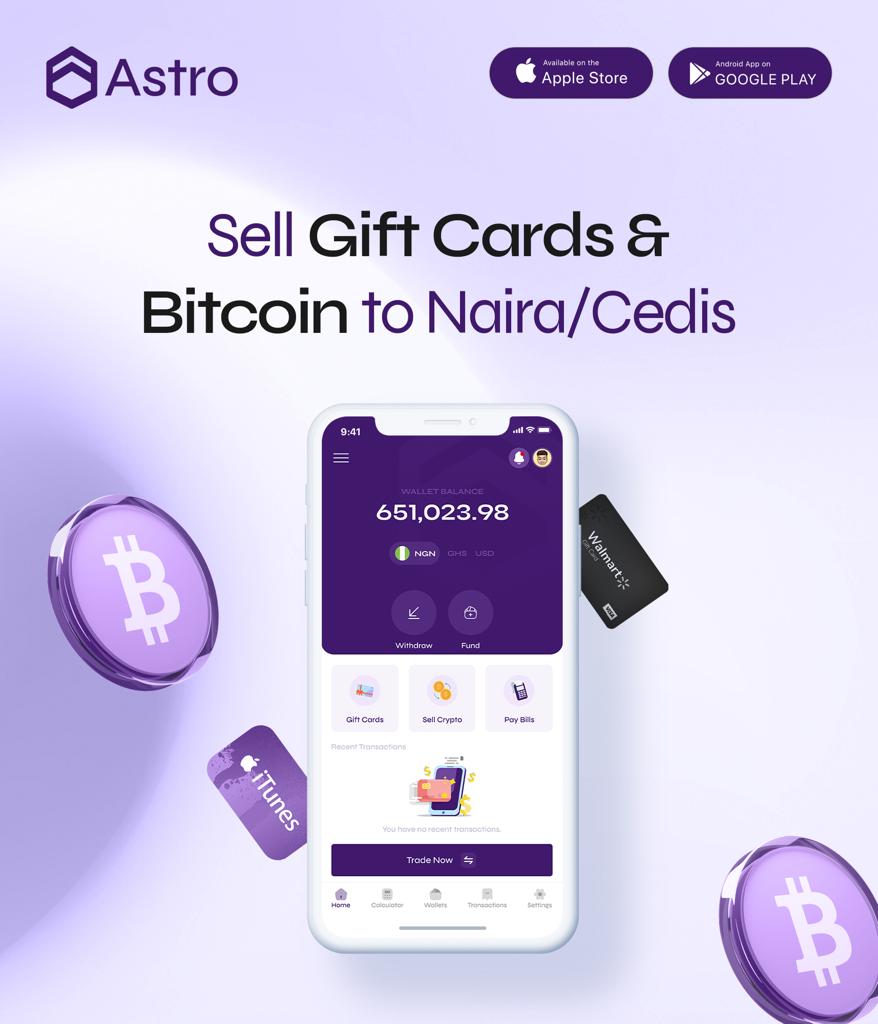
- Crypto. Nigerian users sell supported coins to Astro and receive naira in their Astro wallet, then withdraw to a supported bank account, including OPay and PalmPay. Eligible payouts can arrive in as fast as 60 seconds under normal conditions, though bank delays and maintenance can affect timing.
- Gift cards. Users submit the card in the app, and after it is checked, Astro pays naira (Nigeria) or cedis (Ghana) into the wallet.
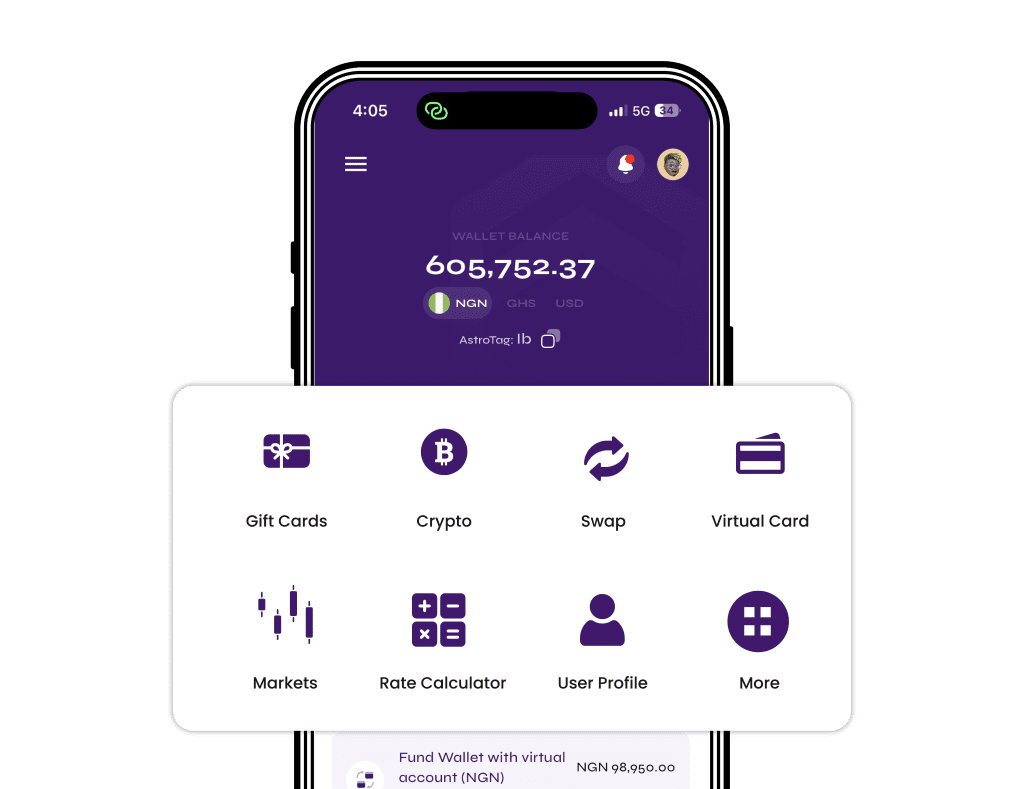
- The record is in the app. Each trade and withdrawal appears in the app’s history with its status, so there is no need to rely on a text message.
The guide what is P2P crypto trading compares the two approaches in more detail. Selling through a platform removes the fake-alert risk from the trade itself, but it does not remove every risk: phishing, fake apps and people posing as support staff still exist, so the habits below still matter.
Other scams that travel with fake alerts
Scammers who use fake alerts often try related tricks:
- Fake “support” agents who ask for your PIN, OTP or recovery phrase. No genuine support agent will ask for these. See what a seed phrase is and why no real agent will ask for it.
- Fake “verification” payments, where you are told to send money or crypto to unlock an account or release a payout.
- Fake websites and apps that copy a real brand’s look. Download Astro only from the official app stores or the link on astroafrica.site.
The wider round-up of tricks to watch for is in crypto scams in Nigeria and how to protect yourself, and account security on Astro covers PIN, Face ID and the optional two-step check.
What to do if you have been tricked
If you released crypto or a gift card code against a fake alert, act quickly:
- Stop all contact with the scammer and don’t send anything else, including “refunds”.
- Save the evidence. Keep screenshots of the chat, the fake alert, the buyer’s account details, wallet addresses and any transaction hashes.
- Contact your bank through its official channels and report the account details the scammer used.
- Report it to the police or the Economic and Financial Crimes Commission (EFCC).
- Report the account to the platform where you met the scammer, such as the P2P marketplace or social media site.
- If Astro was involved in any way, contact Astro support through the in-app chat or at [email protected] with the details.
Crypto that has been sent on the blockchain can’t be reversed, and a redeemed gift card can’t be recovered, so prevention is far more effective than any fix afterwards.
Frequently asked questions
What is a fake bank alert?
It is a false SMS, email or screenshot made to look like a bank credit alert, used to convince someone that money has arrived when it hasn’t.
How can I tell if a credit alert is real?
Log in to your bank app or internet banking yourself and check your available balance. If the money isn’t in your balance, it hasn’t arrived, whatever the message says.
Is a transfer receipt screenshot proof of payment?
No. Screenshots can be made or edited easily. Only the amount in your own account balance confirms a payment.
Why do scammers target crypto and gift card sellers?
Crypto transfers can’t be reversed and gift card codes can be used within seconds. Once a seller releases either one, the scammer has the value and can disappear.
Can a real bank transfer be reversed later?
It can happen if the money came from a stolen or fraudulent account and the bank pulls it back. Matching the sender’s name to the person you are trading with lowers this risk.
Can fake bank alerts happen when selling on Astro?
When you sell to Astro, the payout comes from Astro into your wallet, not from a stranger, so there is no buyer’s alert to fake. Scammers may still pose as Astro staff, so never share your PIN, OTP or recovery phrase.
Someone says they sent money to my account by mistake. What should I do?
Check your real balance in your bank app. If nothing arrived, don’t send anything. If money did arrive, contact your bank rather than sending it back to a number or account the person gives you.
Where should I report a fake bank alert scam?
Report it to your bank through its official channels, the police or the EFCC, and the platform where you met the scammer.
How do I contact Astro if something looks suspicious?
Use the in-app chat or email [email protected]. Astro staff won’t ask for your PIN, OTP or recovery phrase.
Fake bank alerts only work when a seller trusts a message instead of a balance. To sell crypto or gift cards without waiting on a stranger’s transfer, download the Astro app.