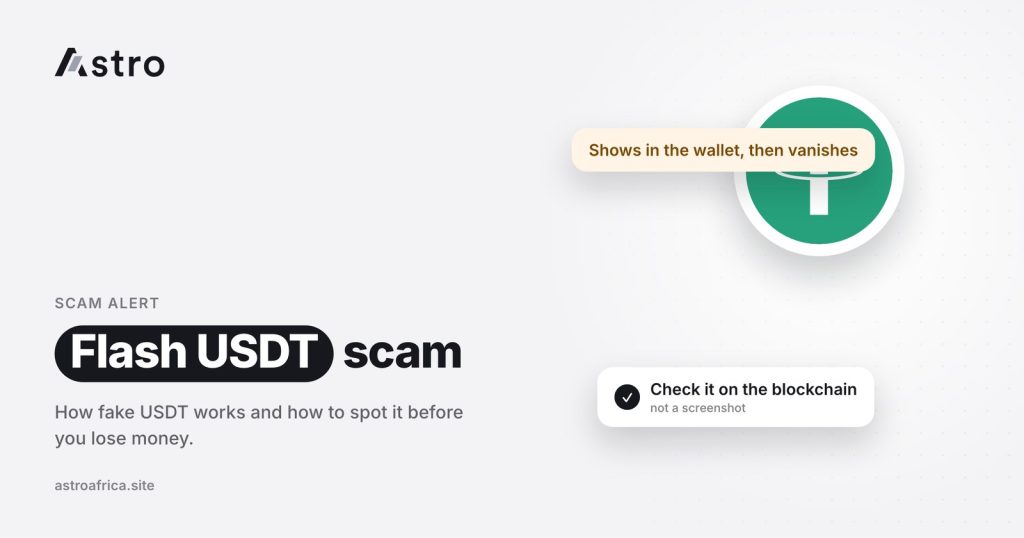
Flash USDT is fake USDT: a token or a fake transaction made to look like real Tether in a wallet or on a screenshot, but which can’t be sold, swapped or withdrawn because it was never real USDT in the first place. Anyone offering to sell you “flash USDT software”, or paying you with USDT that only appears for a few days, is running a scam, and the safest response is to walk away.
This guide explains how the flash USDT scam works, the common versions seen in Nigeria and Ghana, the checks that expose fake USDT, and what to do if someone has already tried it on you.
Key points
- There is no legitimate way to create real USDT that “expires” or disappears after a set time. Flash USDT is fake by design.
- Anyone can create a token called “USDT” or “Tether USD”. The name and logo prove nothing; the token contract is what matters.
- Screenshots, emails and “pending” transaction links are not payment. Only coins that arrive and settle in your own wallet count.
- Selling software that “generates” USDT is itself the scam. The buyer loses the fee and gets nothing usable.
- No app or platform can promise zero fraud risk, but a few simple checks stop almost every flash USDT trick.
What is flash USDT?
USDT (Tether) is a stablecoin that tracks the US dollar. Real USDT is issued by Tether on several blockchains, including Tron (TRC20), BNB Smart Chain (BEP20) and Ethereum (ERC20). On each chain, real USDT comes from one official token contract. That contract is the only source of genuine USDT on that network.
“Flash USDT” is a name scammers use for something that imitates USDT without coming from that official contract. Depending on the version, it can be:
- A copycat token created by the scammer, with the name “Tether USD”, the symbol “USDT” and sometimes the same logo. It shows up in some wallets with a dollar-looking balance, but no exchange or trading app treats it as real USDT.
- A fake transaction, such as an edited screenshot, a forged email from an exchange, or a link to a fake block explorer page showing a transfer that never happened.
- “Flash software” sold online with the promise that it can create USDT that stays in a wallet for 30, 60 or 90 days before vanishing. The software does nothing useful. The money paid for it is the real target.
How the flash USDT scam works
Most flash USDT scams follow one of three patterns. Knowing the pattern makes the scam much easier to spot.
1. The fake buyer
Someone wants to buy your goods, your gift cards, your naira or cedis, or your “real” crypto. They agree to pay in USDT. Soon after, they send a screenshot or a transaction link, or a token labelled USDT really does land in your wallet. They then push you to release what they are buying, quickly. Later you find the “USDT” can’t be sold, can’t be sent, or was never there at all.
2. The software seller
Adverts on Telegram, WhatsApp, TikTok and Facebook offer “flash USDT generators” or “flash BTC software”. The pitch is that you can create a large balance, spend it, and let it disappear later. Once you pay, the seller disappears or keeps asking for more fees.
3. The “you were overpaid” trick
A scammer sends a copycat USDT token to your wallet, then contacts you claiming they sent real USDT to you by mistake. They ask you to “send it back” in real USDT, naira or cedis. Because the fake token sits in your wallet with a balance next to it, the story can look convincing. Sending anything back means losing real money for a token that has no value.
How to spot fake USDT
These checks work whichever network or wallet you use.
Check the token contract, not the name
Open the token in your wallet and look for its contract address, or open the transaction on the network’s official block explorer (Tronscan for TRC20, BscScan for BEP20, Etherscan for ERC20). Real USDT shows the verified Tether token. A copycat token has a different contract address, often with few holders and no trading history. If the contract doesn’t match the official USDT contract for that network, the token is not USDT, whatever it is called.
If you are unsure which network a transfer used, the guide to USDT TRC20 vs BEP20 vs ERC20 explains how the three networks differ and how their addresses look.
Check that the transfer is real and settled
Type the explorer address yourself rather than clicking a link the other person sends. Fake explorer pages are easy to build. Search the transaction ID on the real explorer and confirm three things: the status is successful, the receiving address is yours, and the token is the official USDT. A transaction that only exists in a screenshot or an email does not exist on the blockchain.
Try to use it
Real USDT can be moved, swapped or sold. Copycat tokens usually can’t be sold anywhere, and a wallet may show the balance with no price or a strange price. If USDT in your wallet can’t be sold, or a trading app doesn’t recognise it, treat it as fake until proven otherwise.
Watch the pressure
Scammers rely on speed. “Release the goods now, the transaction is confirmed.” “My boss is waiting.” “Send it back before the network reverses it.” Real payments don’t need you to hurry. If someone won’t wait for you to check, that alone is a warning sign.
Ignore anything that “expires”
Real USDT does not expire after 30 or 90 days. Any offer built on USDT that will “disappear later” is describing fake coins by its own admission.
Why flash USDT targets peer-to-peer deals
Flash USDT works best when two strangers trade directly: one sends goods or money, the other “pays” in USDT. In those deals there is no third party checking what actually arrived, and the person receiving the “USDT” is often under time pressure.
Selling to an app that buys crypto directly removes the stranger from the deal. On Astro, for example, you deposit USDT into your own Astro wallet, and you can only sell what has actually arrived and shows in your balance. There is no buyer sending you screenshots, so the fake-payment version of the scam has nothing to work with. That does not make any platform risk-free. Scammers can still impersonate support staff, send fake payment alerts or try to get your login details, so the habits in the next sections still matter.
For a wider look at the tricks circulating in Nigeria, see the guide to crypto scams in Nigeria and how to protect yourself.
What to do if you received flash USDT
- Don’t send anything. Don’t release goods, don’t “refund” anyone, and don’t send real crypto, naira or cedis to make the problem go away.
- Don’t interact with the token. Some copycat tokens are linked to websites that ask you to “connect your wallet” to claim or swap them. Connecting can give a malicious site permission to move your real coins. Leave the token alone.
- Never share your seed phrase. No real support agent, exchange or “recovery service” needs it. The guide on what a seed phrase is and why no one should ask for it explains why.
- Keep records. Save the chats, wallet addresses, transaction IDs and the scammer’s profile. These help if you report the case.
- Report it. Report the account on the platform where you met the scammer. In Nigeria, cases can be reported to the police or the EFCC. In Ghana, cases can be reported to the police or the Cyber Security Authority.
What to do if you paid for flash USDT software
Stop paying. Sellers often ask for an “activation fee” or “licence upgrade” after the first payment, and each one is lost too. If you paid by bank transfer, contact your bank quickly. If you installed the software, remove it and move any real crypto to a new wallet created on a clean device.
How to protect yourself from flash USDT and similar scams
- Only count a payment as received when the coins have settled in your own wallet and you have checked the token.
- Use the official block explorer for each network, typed in yourself.
- Don’t buy USDT from strangers at a big discount.
- Don’t buy or download “generator”, “flasher” or “mining booster” software.
- Keep your seed phrase, PIN and one-time codes private.
- Turn on every security option your apps offer. On Astro, that includes a 5-digit transaction PIN, Face ID and an optional two-step check with an authenticator app for outside crypto sends. The guide to account security on Astro walks through each one.
- When you send USDT anywhere, match the network on both sides. Crypto sent on the wrong network or as a different coin can’t be recovered, as the guide on sending crypto on the wrong network explains.
Selling real USDT safely in Nigeria and Ghana
If you hold real USDT and want naira or cedis, selling directly in an app avoids stranger-to-stranger deals. On Astro, you copy your USDT deposit address for the network you will send on (TRC20, BEP20 or ERC20), send the USDT on that same network, and sell it once it shows in your balance, checking the rate in the app before you confirm.
Nigerian users can withdraw naira to supported bank accounts, including OPay and PalmPay, and eligible payouts can arrive in as fast as 60 seconds under normal conditions, though banks and maintenance can affect timing. Ghanaian users sell for cedis and withdraw to mobile money (MTN MoMo, Telecel Cash or AirtelTigo Money). Ghana payouts are checked and processed by the Astro team, so timing can vary. If a deposit takes longer than expected, the guide to crypto deposits not showing in your wallet covers the usual reasons.
Frequently asked questions
Is flash USDT real?
No. Flash USDT is not real Tether. It is either a copycat token with no value, a fake transaction, or a story used to sell useless software.
Can flash USDT be sold or withdrawn?
No. Copycat tokens aren’t recognised as USDT by exchanges or trading apps, so they can’t be sold for naira, cedis or any other coin. Fake transactions never reached the blockchain, so there is nothing to withdraw.
Why does fake USDT show a balance in my wallet?
Anyone can create a token and name it “USDT”. Some wallets display any token sent to an address, along with its name and balance. A balance on screen doesn’t mean the token has value. Check the contract address against the official USDT contract for that network.
Does flash USDT disappear after some days?
Scammers often say it does, to explain why it can’t be spent later. Real USDT doesn’t expire. Anything sold as “USDT that lasts 90 days” is fake by definition.
Someone sent me USDT by mistake and wants it back. What should I do?
Don’t send anything. This is a common trick using a copycat token. Check the token contract on the official block explorer. If it isn’t the official USDT contract, ignore the request and block the sender.
How can I check if USDT is real?
Search the transaction ID on the official explorer for the network (Tronscan, BscScan or Etherscan), typed in yourself. Confirm the token is the verified Tether contract, the status is successful and the receiving address is yours.
Can a crypto app guarantee I won’t be scammed?
No app can promise zero fraud risk. Selling to an app directly removes fake-buyer tricks, but you still need to protect your login, PIN and seed phrase and watch for people pretending to be support staff.
How do I contact Astro if something looks wrong?
Use the in-app chat or email [email protected]. Astro staff will never ask for your PIN, password, one-time codes or seed phrase.
Where can I check the USDT rate on Astro?
Crypto prices are shown in the Astro app before you confirm a sale. Rates move with the market, so check the app at the time you sell.
Flash USDT only works when someone accepts a screenshot, a token name or a hurried promise as payment. Check the contract, check the blockchain yourself, and never pay for software that claims to create money. When you have real USDT to turn into naira or cedis, download the Astro app and sell only what has actually landed in your wallet.