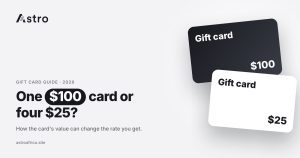
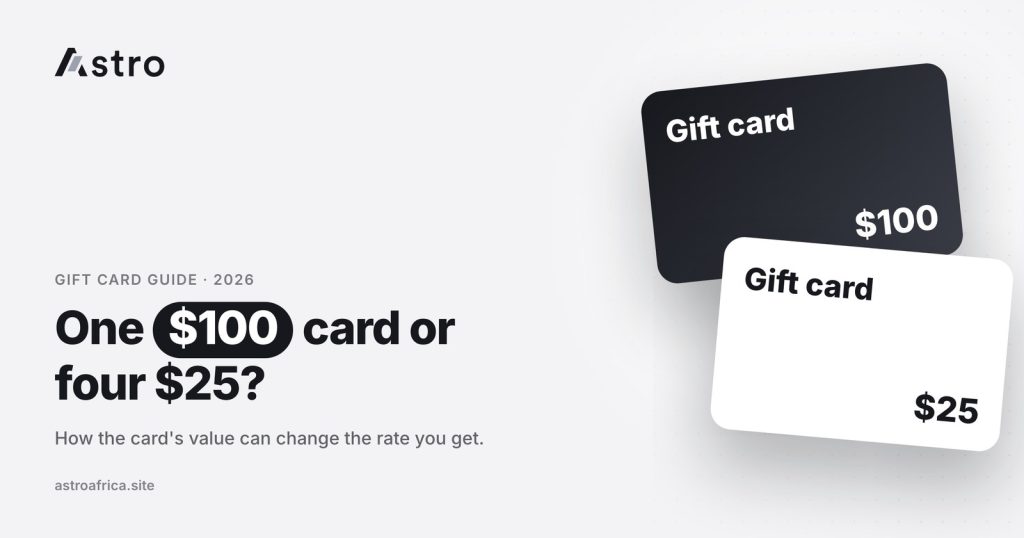
A single $100 gift card and four $25 cards add up to the same face value, but they often don’t sell for the same amount, because gift card rates are set by denomination band and larger cards frequently sit in a band with a higher rate per dollar. On some cards the bands pay the same, and some cards are not accepted at all below a certain value, so the only reliable way to compare is to check the live rate for your exact card, country and value before you sell.
This guide explains what a denomination is, how rate bands work, why a bigger card can be worth more per dollar, which popular cards have minimum values, and what people in Nigeria and Ghana should check before buying or selling cards in different amounts.
Key points
- Denomination means the face value of one card, such as $25, $50 or $100.
- Rates are set in value bands (for example $50–$99 and $100–$299), not as one rate for every amount.
- On many cards the higher band pays more per dollar. On some, the bands pay the same. It is never safe to assume.
- Some cards are only accepted from a minimum value. Walmart and Target, for example, are accepted as USA physical cards from $100 to $500 only.
- Always check the band for your exact card on the live rates page before you sell.
What does “denomination” mean on a gift card?
The denomination is the value printed on, or loaded onto, a single card. A $100 Apple card has a denomination of $100. Four $25 Apple cards have a combined value of $100, but each card’s denomination is still $25.
When you sell, the rate is worked out per card, based on that card’s own value. A trader does not add your four $25 cards together and treat them as one $100 card. Each one is checked and priced on its own, in the band that matches its value.
How gift card rate bands work
Gift card buyers don’t usually set a separate rate for every possible value. Instead, they group values into ranges, often called bands. Each band has its own rate per dollar. On Astro, the band names look like this:
- USA Nordstrom physical: $50–$99, $100–$299 and $300–$500.
- USA Apple physical: $15–$99, and $100–$500 for a single card.
- USA eBay physical: $25–$49, $50–$99 and $100–$200.
- USA Foot Locker physical: $50–$99 and $100–$500.
- USA Macy’s: $50–$99 and $100–$400.
So a $100 Nordstrom card is priced in the $100–$299 band, while a $50 Nordstrom card is priced in the $50–$99 band. If those two bands carry different rates, the two cards earn different amounts per dollar, even though they are the same brand from the same country.
Bands are only one part of the price. Card type, country, whether the card is physical or an e-code, and whether a receipt is needed all play a part too. The guide on how gift card rates are set in Nigeria and Ghana explains each factor.
Why a larger card can get a better rate per dollar
Across the market, larger cards often attract a higher rate per dollar. A few practical reasons sit behind this:
- Less handling per dollar. Checking and processing one $100 card takes about the same effort as checking one $25 card. Four small cards mean four checks for the same total value.
- Demand from resale buyers. Many end buyers want larger values, so bigger cards are often easier to move on.
- Fewer small-card problems. Smaller cards are more often bought in bulk, shared around, or drained before they reach a seller, which adds risk for the buyer.
That said, this is a pattern, not a rule. On Astro’s live rates, some cards pay a higher rate in the larger band, while others, such as USA Nike and USA Roblox, currently show the same rate across their bands. Rates also move with the market, so a gap that exists today may close tomorrow, or the other way round.
One $100 card vs four $25 cards: a worked comparison
Without quoting any rate, here is how the comparison plays out for a card with two bands, say $25–$99 and $100–$500:
| One $100 card | Four $25 cards | |
|---|---|---|
| Total face value | $100 | $100 |
| Band used for pricing | $100–$500 | $25–$99 (for each card) |
| Rate per dollar | The higher-band rate | The lower-band rate |
| Cards to upload and check | 1 | 4 |
| Chance one card has a problem | One card to go wrong | Four separate cards, each checked on its own |
If the higher band pays more per dollar, the single $100 card earns more. If both bands pay the same, the total is the same, but the single card is still quicker to upload. The only way to know for your card is to compare the two bands on the rates page.
Cards with a minimum value
For some brands, small cards are simply not accepted. This matters if you are deciding what value to buy or receive. Based on the cards Astro currently has live rates for:
- Walmart: USA physical cards from $100 to $500 only. See how to sell a Walmart gift card.
- Target: USA physical cards from $100 to $500 only. See how to sell a Target gift card.
- Nike: USA cards from $100.
- Coach and Finish Line: physical cards from $100 to $500.
- Saks Fifth Avenue: USA physical cards from $500 to $2,000.
Other cards accept smaller values. USA Steam starts at $20, Google Play USA and UK start at $25, and USA Apple physical cards start at $15. Accepted values differ by country, so a range that applies to a USA card may not apply to a UK or Canadian one.
Four $25 Walmart cards, in other words, are not just a weaker deal than one $100 card. They can’t be sold on Astro at all right now.
Physical vs e-code bands
The same brand and value can sit in different bands depending on whether the card is physical or an e-code. USA Apple, for instance, has separate bands for physical cards and e-codes, and USA eBay has separate physical and e-code bands too. When you compare a $100 card against four $25 cards, compare like with like: physical against physical, or e-code against e-code. The guide to e-code vs physical gift cards explains why the two are priced differently.
Country matters as much as value
A $100 card from the USA and a 100-unit card from Canada, Australia or Europe are different products with different bands and rates. Some countries also have very different value ranges. Japanese Apple cards, for example, are listed in yen, from 5,000 upward. Always choose the right country first, then the right value. If you are not sure where your Apple card is from, see which country your Apple gift card is from.
What to check before you sell
- Brand and country. Make sure the card you are selling has a live rate for its country.
- Physical or e-code. Pick the right type in the app.
- Value of each card. Find the band that matches each card’s own value, not the total.
- Receipt. Some bands need a receipt. Read the terms shown for that band in the app.
- The rate on submission. If the rate changes before you submit, the sale goes through at the new rate. Once submitted, a sale can’t be cancelled.
Upload each card in the correct section. A card uploaded under the wrong value or country can be moved to the right section and paid at that section’s rate, which may be different from what you expected.
A note on buying cards to resell
Some people buy gift cards specifically to sell them on. If that is you, the band structure matters before you buy, not just when you sell. Check which values are accepted and how the bands compare first. Also be aware that rates move, so a gap between bands is not a fixed margin you can count on. Avoid buying cards from strangers or unofficial sellers, since drained or stolen cards are a real risk. The guide on gift card draining explains how a brand-new card can turn up empty.
How payment works in Nigeria and Ghana
In Nigeria, gift card sales are paid in naira to your Astro wallet, and you can withdraw to supported bank accounts, including OPay and PalmPay. In Ghana, sales are paid in cedis, and withdrawals go to mobile money: MTN MoMo, Telecel Cash (formerly Vodafone Cash) or AirtelTigo Money. Ghana withdrawals are checked and paid by the Astro team, so timing can vary. Bank payouts in Ghana are not available at the moment.
Frequently asked questions
Is a $100 gift card worth more than four $25 cards?
Often, but not always. Larger cards frequently fall in a band with a higher rate per dollar. On some cards both bands pay the same. Compare the bands for your exact card on the rates page.
What is a gift card rate band?
It is a value range, such as $50–$99 or $100–$299, that shares one rate per dollar. Each card is priced in the band that matches its own value.
Can I combine small cards to get the large-card rate?
No. Each card is checked and priced on its own value. Four $25 cards are priced as four $25 cards, not as one $100 card.
Why don’t some cards accept $25 or $50 values?
Rates are only offered for values with steady demand. For example, Walmart and Target are accepted on Astro as USA physical cards from $100 to $500 only.
Do e-codes and physical cards use the same bands?
Not always. Many cards have separate bands for physical cards and e-codes, so compare like with like.
Does the time of day affect my rate?
No. Rates on Astro don’t depend on the time of day. They change with the market, not with business hours.
Where can I see today’s rate for each band?
The live rates page lists gift card rates in naira and cedis. The app also shows the rate for your card before you submit.
What happens if I upload a card under the wrong value?
It can be moved to the correct section and paid at that section’s current rate. Choose the right country, type and value before you submit, because a sale can’t be cancelled after submission.
Can people in Ghana sell gift cards on Astro?
Yes. Ghanaian customers can sell gift cards and are paid in cedis, then withdraw to mobile money.
Who do I contact about a gift card sale?
Use the in-app chat or email [email protected], and include your trade details and card images.
Denomination is one of the easiest rate factors to check and one of the most often ignored. Before you sell, look up the band for each card’s own value, then download the Astro app to see the rate for your exact card and sell in a few taps.