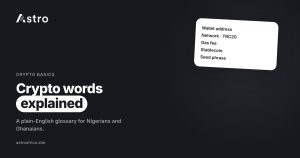
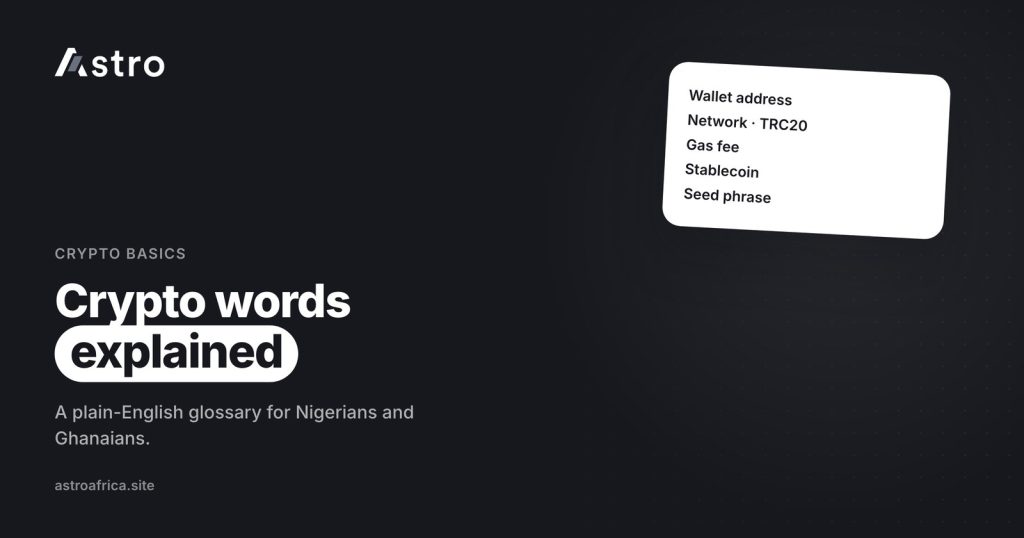
Most crypto terms have simple meanings once the jargon is removed: a wallet is where your coins are held, a network is the blockchain they travel on, gas is the fee for moving them, and a seed phrase is the master key to a self-held wallet. This glossary explains the words people in Nigeria and Ghana meet most often, in plain English, with a link to a fuller guide where one exists.
The terms are grouped by topic, so you can read one section at a time or jump to the word you need.
Key points
- Learn the five words that cause most costly mistakes first: network, address, gas, seed phrase and confirmation.
- Crypto sent on the wrong network, or sent as a different coin, can’t be recovered.
- No genuine support agent, from Astro or anywhere else, will ever ask for your seed phrase or PIN.
- On Astro, limit orders are crypto-to-crypto only. They don’t set a naira or cedi cash-out rate.
- Rates move with the market, so this glossary doesn’t quote any. Check the app, or today’s gift card rates.
The basics
Cryptocurrency (crypto). Digital money that moves on a blockchain rather than through a bank. Bitcoin (BTC), Ethereum (ETH) and Tether (USDT) are examples.
Blockchain. A shared public record of transactions, kept by many computers at once. Once a transaction is recorded and confirmed, it can’t be edited or reversed.
Coin vs token. A coin is the native currency of its own blockchain, such as BTC on Bitcoin, ETH on Ethereum or TRX on Tron. A token is issued on top of another chain. USDT is a token, which is why it exists on several networks.
Stablecoin. A token designed to hold a steady value, usually one US dollar. USDT and USDC are the most common. “Stable” describes the aim, not a guarantee. The difference between holding dollars and holding USDT is covered in dollar to naira vs USDT to naira.
Peg. The target price a stablecoin tries to hold, such as $1. A stablecoin that drifts away from that price is said to have “lost its peg”.
Altcoin. Any coin other than Bitcoin, such as ETH, BNB, SOL, LTC or DOGE.
Satoshi (sats). The smallest unit of Bitcoin: one hundred-millionth of a BTC. People often speak of small Bitcoin amounts in sats.
Mining. The process by which some blockchains, including Bitcoin, add new blocks and release new coins, using powerful computers.
Halving. A scheduled event on Bitcoin that cuts the reward for mining new blocks in half, roughly every four years. More in what Bitcoin halving is.
Smart contract. A small program that runs on a blockchain. Tokens such as USDT on Tron, BNB Smart Chain and Ethereum are managed by smart contracts.
Wallets and keys
Wallet. An app or device that lets you hold, receive and send crypto. The beginner’s guide to crypto wallets explains the main types.
Custodial wallet. A wallet where a company holds the keys for you, such as an exchange account or the wallet inside a trading app like Astro. You sign in with your account, and the company handles the blockchain side.
Self-custody (non-custodial) wallet. A wallet where only you hold the keys, such as Trust Wallet or MetaMask. You have full control, and full responsibility. If you lose the seed phrase, no one can restore the wallet.
Seed phrase (recovery phrase). A list of 12 or 24 words that can restore a self-custody wallet on any device. Anyone who has it can take everything in the wallet. Read what a seed phrase is and why no real agent will ask for it.
Private key. The secret code that proves you own a wallet address and lets you send from it. A seed phrase is a human-readable way of storing private keys.
Hot wallet vs cold wallet. A hot wallet is connected to the internet, such as a phone app. A cold wallet stays offline, such as a hardware device. Cold wallets are used for long-term storage.
Sending and receiving
Address. The string of letters and numbers you share to receive crypto, like an account number. Tron addresses start with “T”; BNB Smart Chain and Ethereum addresses start with “0x”. Always copy and paste, then check the first and last few characters.
Network (chain). The blockchain a coin travels on. USDT, for example, can travel on Tron (TRC20), BNB Smart Chain (BEP20) or Ethereum (ERC20). The network chosen when sending must match the receiving side. See USDT TRC20 vs BEP20 vs ERC20.
TRC20, BEP20, ERC20. Token standards on Tron, BNB Smart Chain and Ethereum. In everyday use, they are shorthand for “USDT on that network”.
Wrong-network transfer. Sending crypto on a different network from the one the receiver expects. Crypto sent on the wrong network, or sent as a different coin, can’t be recovered. More in sent crypto on the wrong network.
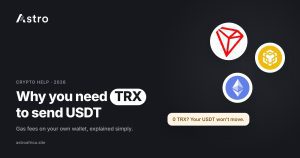
Gas (network fee). The fee paid to the network to process a transaction, charged in the chain’s own coin: TRX on Tron, BNB on BNB Smart Chain, ETH on Ethereum. A self-custody wallet needs some of that coin to send tokens. See why you need TRX, BNB or ETH to send USDT.
Gwei. A tiny unit of ETH used to describe Ethereum gas prices.
Energy and bandwidth. Tron’s resources for processing transactions. Token transfers use energy; if a wallet has none staked, it burns TRX instead.
Confirmation. Each time the network adds another block after your transaction, it gains a confirmation. Platforms credit deposits after a set number, so a transfer can be “sent” but not yet credited. If a deposit hasn’t appeared, read crypto deposit not showing.
Transaction ID (TxID or hash). A unique code for every blockchain transaction. You can paste it into a block explorer to see its status.
Block explorer. A public website that shows blockchain transactions, such as Tronscan for Tron or Etherscan for Ethereum. Learn more in how to track blockchain transactions.
Memo or tag. An extra code some exchanges require for certain coins so they can tell whose deposit it is. If a receiving screen shows one, include it exactly.
Test transaction. A small first transfer sent to check an address and network before sending a larger amount.
Trading and prices
Exchange. A platform where people buy, sell and swap crypto, such as Binance, Bybit or OKX.
P2P (peer-to-peer). Trading directly with another person, often through an exchange’s P2P board, where you pay or get paid by bank transfer or mobile money. It carries its own risks, including fake payment alerts. See what P2P crypto trading is.
Rate. The price at which a platform buys or sells a coin in naira or cedis. It moves with the market. Why the USDT to naira rate changes explains the main drivers.
Spread. The gap between the price to buy a coin and the price to sell it on the same platform.
Volatility. How sharply a price moves up and down. Bitcoin and most altcoins are volatile; stablecoins aim not to be.
Market order. A trade that goes through straight away at the current price.
Limit order. An order that only goes through when the price reaches a level you set. On Astro, limit orders are crypto-to-crypto only, for example BTC to USDT; they don’t set a target naira or cedi cash-out rate. See crypto limit orders for beginners.
Swap. Changing one coin for another in a single step. Astro’s Instant Swap is covered in how to swap BTC, ETH and USDT.
Slippage. The difference between the price you expected and the price you actually got, which can happen when prices move fast.
Cash out (off-ramp). Turning crypto into local money such as naira or cedis.
HODL. Slang for holding crypto rather than selling, from an old misspelling of “hold”.
FOMO and FUD. FOMO is “fear of missing out”, which pushes people to buy in a rush. FUD is “fear, uncertainty and doubt”, which pushes people to sell in a panic. Both lead to rushed decisions.
DYOR. “Do your own research.” Good advice, often used by people promoting a coin they want you to buy.
Accounts, security and status
KYC (know your customer). Identity checks such as BVN, ID or a selfie. On Astro, sign-up doesn’t ask for ID, and crypto trading and crypto withdrawals don’t need ID verification, but some features do. See what needs verification on Astro.
Transaction PIN. The 5-digit code that confirms payments in the Astro app. Face ID can also unlock the app and confirm payments.
2FA (two-step check). A second code, often from an authenticator app, on top of your password or PIN. Astro offers an optional two-step check on outside crypto sends and Astro Tag crypto sends. More in account security on Astro.
Astro Tag. A username for sending crypto to other Astro users without a blockchain address. Crypto sends by Astro Tag are free. See how Astro Tag works.
Processing vs Pending. On Astro, “Processing” means Astro is working on your withdrawal, swap or sale. “Pending” means it is waiting on something outside, such as network confirmations. Read “Processing” vs “Pending”.
Scam words to know
Phishing. Fake messages, sites or apps that try to steal your login, PIN or seed phrase. Learn to spot fake Astro pages and agents.
Flash USDT. Fake USDT that appears in a wallet but has no value and can’t be sold. See the flash USDT scam.
Clipboard hijacking. Malware that swaps a copied address for the scammer’s address. Always check the pasted address. More in what clipboard jacking is.
SIM swap. When a fraudster takes over your phone number to receive your codes. See SIM swap fraud.
Fake bank alert. A forged credit message used to trick sellers into releasing crypto or gift cards before real money arrives. See fake bank alert scams.
Rug pull and pump and dump. A rug pull is when a project’s creators vanish with investors’ money. A pump and dump is when a group hypes a coin, sells at the top and leaves others with losses.
For a broader view of what to watch for, read crypto scams in Nigeria and how to protect yourself. No app or platform can promise zero fraud risk, so habits matter.
Frequently asked questions
What are the most important crypto terms for beginners?
Wallet, address, network, gas, seed phrase and confirmation. Most costly mistakes come from misunderstanding one of these.
What is the difference between a coin and a token?
A coin is the native currency of its own blockchain, like BTC or ETH. A token runs on another chain, like USDT on Tron or Ethereum.
What does TRC20 mean?
It is the token standard on the Tron network. “USDT TRC20” means USDT that travels on Tron.
What does gas mean in crypto?
Gas is the network fee for processing a transaction, paid in the chain’s own coin, such as TRX, BNB or ETH.
What is a seed phrase used for?
It restores a self-custody wallet. Anyone with it can take your funds, so never share it with anyone, including people claiming to be support.
What is a stablecoin?
A token designed to hold a steady value, usually one US dollar. USDT and USDC are the most common examples.
What does KYC mean on a crypto app?
Identity checks. On Astro, crypto trading and crypto withdrawals don’t need ID verification, but some features do.
What is a limit order?
An order that only goes through at a price you set. On Astro, limit orders are crypto-to-crypto only.
What does HODL mean?
Slang for holding crypto instead of selling it.
Where can I get help with a crypto term or transaction?
Use the in-app chat or email [email protected]. The Astro customer care guide lists the official channels.
Crypto feels less confusing once the words make sense. Keep this glossary handy, learn the five terms that cause the most mistakes, and take your time before every transfer. When you’re ready to buy, sell, swap or hold, download the Astro app.